
For Philippine SMEs, the stakes are practical: the Bureau of Internal Revenue (BIR) expects accurate, supported records, lenders and investors want reliable financial statements, and you need to know whether the business actually made money. Messy books at year-end lead to late filings, penalties, missed deductions and stressful audits.
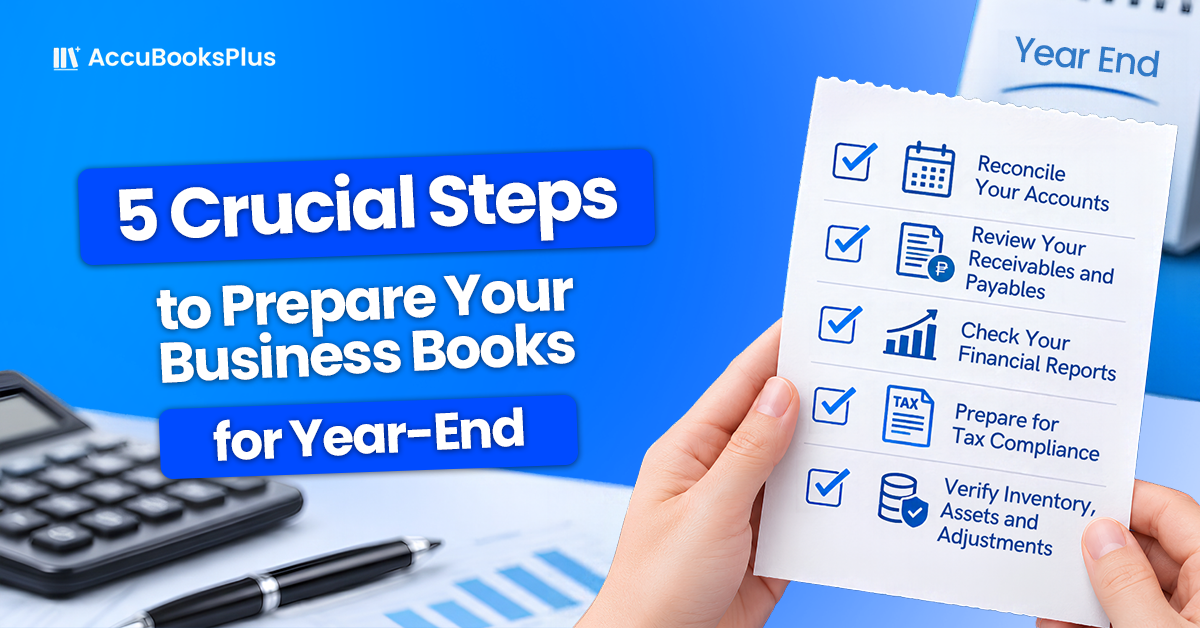
The good news: a clear checklist turns year-end from a scramble into a routine. Here are five crucial steps.
Step 1: Reconcile Every Account
Reconciliation is the foundation of accurate books. It confirms that what your records say matches what actually happened.
What to do:
- Reconcile all bank accounts against your December bank statements, including digital wallets and payment platforms.
- Match credit card and loan balances to lender statements.
- Investigate unrecorded deposits, unexplained charges, duplicate entries and outstanding checks.
- Confirm that cash on hand matches your petty cash records.
Pro tip: Reconcile monthly, not just at year-end. Problems found in March are far easier to fix than problems found in the final week of December.
Step 2: Review Your Receivables and Payables
Unpaid invoices and unpaid bills directly affect your cash flow and your reported income and expenses.
What to do:
- Review your accounts receivable aging report and follow up on overdue customer invoices.
- Decide which invoices are unlikely to be collected and handle them according to your accountant's guidance.
- Review your accounts payable and make sure all supplier bills for the year are recorded, even those not yet paid.
- Record accrued expenses such as utilities, rent, salaries and professional fees that belong to the year but have not been billed or paid.
- Check that every sale has a proper invoice or receipt and that every expense has supporting documents.
Automated invoicing and payment tracking make this step much faster, because overdue accounts are flagged for you instead of hiding in a spreadsheet.
Step 3: Verify Inventory, Assets and Adjustments
If your business sells products, your inventory value affects your cost of goods sold and your profit. If you own equipment, vehicles or other assets, they need to be properly recorded too.
What to do:
- Conduct a physical inventory count and compare it with your system records.
- Resolve discrepancies from damaged, expired, lost or unrecorded items.
- Review your fixed assets list: record new purchases, remove disposed items and apply depreciation.
- Record year-end adjusting entries, such as prepaid expenses, accruals and depreciation.
- Review any advances, loans or funds released to employees or partners and make sure they are properly recorded and liquidated.
Pro tip: A built-in inventory management feature that tracks stock in and out, balances and top-selling products makes your year-end count far easier, since your system already shows what should be on the shelves.
Step 4: Organize Your BIR and Compliance Records
This is where many Philippine businesses lose time. Year-end is when compliance paperwork piles up, so organize it early.
What to do:
- Gather and file official receipts, sales invoices and supporting documents for the year.
- Collect withholding tax certificates, such as BIR Form 2307 from customers, and make sure the ones you issued are complete.
- Review payroll records, including 13th month pay obligations and employee benefit contributions.
- Check that your books of accounts are complete and up to date.
- Note the filing dates for your annual returns, information returns and other year-end requirements, and confirm them with the BIR or your accountant, since rules and deadlines can change.
Keeping records digital and organized means you can retrieve any document in seconds when the BIR, an auditor or a bank asks for it.
Step 5: Generate and Review Your Financial Reports
Once your records are reconciled and adjusted, it is time to see the full picture.
What to do:
- Generate your core financial statements: the income statement, the balance sheet and the cash flow statement.
- Review them for anything unusual, such as sudden spikes in expenses, negative balances or accounts that do not make sense.
- Compare this year's results with last year's and with your budget.
- Review your profit margins, cash position and outstanding obligations.
- Share the reports with your accountant or financial advisor before closing the books.
- Set goals and a budget for the new year based on what the numbers tell you.
This step turns bookkeeping from a compliance task into a decision-making tool. Your year-end reports show what worked, what did not and where to focus next.
How AccuBooks Plus Makes Year-End Easier
Doing all five steps manually in spreadsheets is possible, but it is slow and error-prone. AccuBooks Plus is an accounting system built to keep your business BIR-ready all year round, so year-end is a review, not a rescue mission. With AccuBooks Plus you can:
- Automate invoicing and track who has paid and who has not.
- Keep bookkeeping organized with records that stay current throughout the year.
- Manage inventory with real-time stock levels, quantities in and out, and reports you can export.
- Track funds and advances and requests for payment in one place.
- Generate financial reports whenever you need them, not just at year-end.
A strong year-end starts with clean books: reconcile your accounts, review your receivables and payables, verify your inventory and assets, organize your BIR records and review your financial reports. Do these five things and you will close the year with confidence and open the new one with clarity.
Ready to make next year-end easier? Book a free 20 to 30 minute online demo of AccuBooks Plus and see how automated invoicing, bookkeeping and BIR-ready reports can work for your business: Book your free demo
Leave a comment